



Short selling is a valuable tool used by hedge funds to generate superior returns and manage risk in all market conditions. It allows hedge fund managers to profit from falling prices, reduce market exposure, and lower portfolio volatility. Hedge fund managers can utilize short selling strategies such as reducing market or sector exposure, implementing pair trading strategies, and profiting from company-specific factors, enhancing their ability to deliver risk-adjusted returns over the long term.
- article
- 3 min read
- 18 November 2022

The practice of short selling has long been a mystic topic to many, obfuscated by perceptions of it being a predatory and highly risky strategy. The truth is that short selling is a vital tool in the toolkit of hedge funds, which gives the hedge fund manager the ability to generate superior returns in all market conditions, regardless of whether share prices go up or down. It
AJ Snyman, Investment Analyst at Peregrine Capital further helps to manage risk, reduce portfolio volatility, lower market exposure and minimise correlation to the broader market.
If a typical unit trust manager does not like a share in his investable universe, the best he can do is not to own the share. Often, funds that are benchmark cognisant will declare victory for being “underweight” on an underperforming company, despite still losing money for investors when the share price declines. Hedge funds, on the other hand, can take advantage of falling prices by short selling securities, while long only unit trusts cannot.
What is short selling? When you buy a share, you pay cash now for that asset and hope for it to appreciate in the future. Doing so, assumes that the investment will go up in value. If that happens and you sell the share, you receive cash for it; the difference between this and your purchase price is the profit. With short selling, this process works in reverse.
Suppose apples cost R2 each at the market today and you are of the view that, because of the anticipated big harvest of apples, the price of apples should decrease. Since you don’t own any apples, you approach your friend who has 10 apples and you ask him if you could borrow these apples, with the promise that you will return 10 apples to him in future (he doesn’t plan to do anything with the apples right now but would like to bake apple pie at some point in the coming month). For the privilege of borrowing his apples, you pay him a small fee. You then go to the market and sell these 10 apples at the current price of R2 each and earn yourself R20 in cash. After a week, you return to the market and as you expected, the price of apples have dropped to R1! You use the R10 of the R20 you raised by selling your apples and buy 10 apples back from the market vendor, paying him R10 total. This now leaves you with 10 apples and R10 in cash. You return these 10 apples to your friend as promised and you are left with R10 in profit!
The role of short selling While the practice of short selling is an additional tool at the disposal of hedge fund managers, short selling can be utilised in different ways and fulfils multiple functions. An effective short selling strategy provides protection against adverse events and allows a hedge fund manager to reduce sector or market exposure and a portfolio’s correlation with the overall market.
Short selling serves different purposes within a hedge fund:
Reduce a portfolio’s market or sector exposure
From a portfolio perspective, selling short either individual stocks or an index allows a hedge fund manager to hedge out market risk and to protect the fund’s long positions against a broad stock market decline.
Such practice also helps reduce the portfolio’s correlation to the overall market and in most cases, brings the portfolio volatility down, thereby increasing the probability that a hedge fund delivers superior risk-adjusted returns in different market conditions.
Pair trading strategies
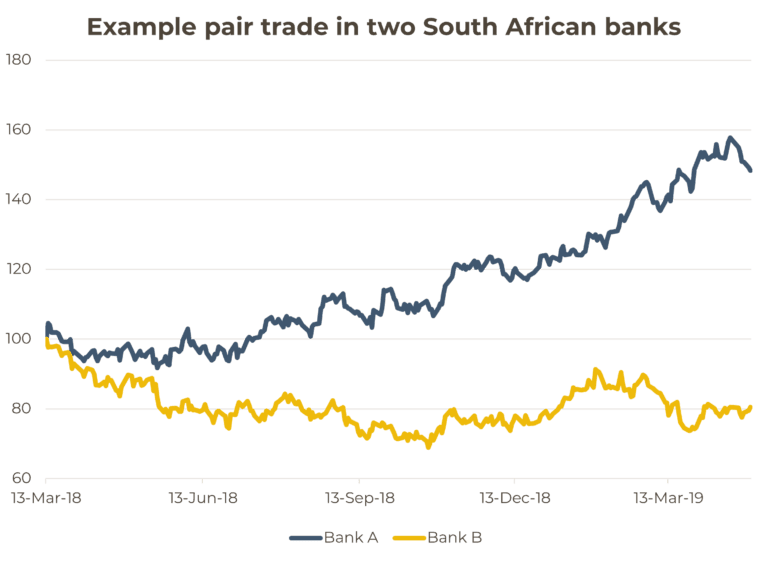
In a pair trading strategy, the fund manager will buy shares in Company A and sell short shares in Company B, both of which often share similar characteristics such as belonging to the same industry (banks, retailers) or being exposed to the same underlying business drivers (specific input cost, same end-consumer).
By implementing a pair trading strategy, the manager eliminates exposure to broader market moves and is only interested in the relative performance between the two shares. In an ideal situation, the fund manager would have Company A’s share price increase and Company B’s share price decline, thereby making profit on both the long and the short positions. However, this does not need to always be the case. This strategy can make profit in both a rising and declining market environment, as long as the relative performance of the one share price, more than offsets the loss incurred in the move of the other share price.
This strategy is typically implemented when a fund manager has a fundamental view that either Company A should perform well but still wants to reduce the overall exposure to the market and thereby shorting Company B or when the manager thinks that Company A will perform better than Company B and thus look to profit of this relative difference in underlying fundamental performance.
Below is an example of such a pair trade which Peregrine Capital executed in the past:
Outright shorts
The last, and least common function of short selling involves short selling a company’s share on a standalone basis, attempting to profit from a decline in the share price for fundamental or other company-specific reasons.
This type of short selling is typically based on extensive fundamental or quantitative research to identify the specific factors that should lead to a decline in the company’s share price.
Examples of company-specific factors include fundamental overvaluation, potential breach of debt covenants resulting in capital raise, fraud, weakening revenue and earnings momentum or specific events in the company’s life like a merger or acquisition.
While these types of short sale trades typically receive the most airtime in the media, they are difficult to identify and less frequently utilised within Peregrine Capital funds.
Short selling is a common and essential tool that only hedge fund managers have at their disposal. It plays a vital role in protecting portfolios against downside risk, lowers exposure to general market movements, unlocks profit from relative share price performance and profits from declining share prices.
Short selling enables hedge fund managers like Peregrine Capital to deliver risk-adjusted returns for investors over the medium and long-term. The question investors must ask their fund manager is whether they have all the (right) tools in their shed.
Stay connected
Subscribe to Peregrine Capital's regular communications. Gain access to up-to-date news and insights from our world of Hedge Funds, delivered straight to your inbox.
Stay informed. Stay Educated.